
Acne Scar Revision
Restoring structural integrity and refining skin texture.
Our Approach
While active breakouts can be managed, the severe inflammation they cause often leaves behind a more permanent reminder: acne scarring. At Pilot Medical Clinic, we view scar revision as a restorative architectural process. By carefully analyzing the depth, type, and severity of dermal indentations, we map out a precision-driven protocol to rebuild collagen, smooth irregularities, and return the skin to its natural, unblemished state.
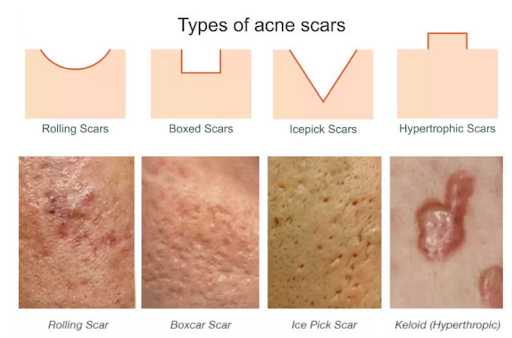
The Morphology of Acne Scars
Acne scars form when a breakout penetrates the skin deeply and damages the underlying tissues. As the skin tries to heal itself, it may produce too little or too much collagen. Effective treatment requires an accurate classification of your specific scar profile:
Ice Pick Scars: Deep, narrow, V-shaped indentations that look like small puncture marks. They extend deeply into the dermis and are typically the most challenging to treat with surface lasers alone.
Boxcar Scars: Broad, rectangular depressions with steep, well-defined edges. They are often found on the lower cheeks and jawline.
Rolling Scars: Wide depressions with sloping, rounded edges that give the skin a wave-like or undulating appearance. These are caused by bands of fibrous tissue tethering the skin to the deeper structures.
Hypertrophic Scars: Raised, firm ridges of tissue that occur when the body produces excess collagen during the healing process.
Clinical Solutions at Pilot Medical Clinic
Led by our Medical Director, Dr. Jason Lau, whose foundational medical background includes clinical experience at Massachusetts General Hospital, and Singapore General Hospital, our approach to scar revision relies on layered, evidence-based modalities. Because most patients present with a combination of scar types, a single treatment method is rarely sufficient.
We utilize a multi-pronged strategy tailored to your specific dermal needs:
Subcision: A minor surgical technique used to physically break the fibrous bands that tether rolling scars downwards, allowing the skin to lift and instantly improving the undulating texture.
TCA CROSS (Chemical Reconstruction of Skin Scars): The application of high-concentration trichloroacetic acid directly into the base of deep ice pick and narrow boxcar scars to stimulate localized collagen production and elevate the scar floor.
Advanced Fractional Lasers: Utilizing cutting-edge light therapy to create micro-injuries in the skin, prompting a profound healing response that resurfaces the top layer while remodeling deeper collagen networks.
Collagen-Stimulating Injectables & Skin Boosters: Injecting targeted dermal fillers or polynucleotides (such as salmon DNA) beneath the scars to immediately plump depressions and provide the necessary building blocks for long-term tissue repair.
Find out more about Acne treatments, Enlarge pore treatments, Glass Skin treatments
Expertly reviewed by the Pilot Medical Team.
Questions?
-
While modern dermatological treatments are highly advanced, it is medically inaccurate to promise 100% "removal" of scars. Our goal is revision and minimization. Most patients can expect a 50% to 80% improvement in scar texture, making them significantly less noticeable to the naked eye.
-
Because scar tissue is complex and dermal remodeling takes time, acne scar revision is a journey rather than a single event. Depending on the severity of the scarring and the chosen modalities, patients typically require between 3 to 6 sessions, spaced 4 to 6 weeks apart, to achieve optimal outcomes.
-
Patient comfort is a priority at Pilot Medical Clinic. We utilize high-strength topical numbing creams, and in some cases, localized anesthetics prior to procedures like subcision or fractional lasers. Most patients report only mild, highly tolerable discomfort.
-
Downtime varies by treatment. Skinbooster and subcision may result in localized redness, swelling, or minor bruising for 3 to 7 days. Fractional laser treatments generally involve a sunburn-like redness and mild peeling that resolves within 5 to 7 days. We will provide a strict post-care regimen to accelerate healing.
-
Yes. However, darker skin types carry a higher risk of post-inflammatory hyperpigmentation (PIH) when subjected to aggressive heat or chemical treatments. Dr. Lau carefully calibrates laser settings and selects modalities (such as subcision or microneedling radiofrequency) that bypass the skin's surface melanin to ensure safe, effective results for all ethnicities.
Begin Your Skin Revision Journey
Scar tissue requires expert intervention. Schedule a comprehensive assessment with our clinical team to map out a targeted treatment plan for smoother, healthier skin.